Which Burns Leave Scars?
Burn scars form when a deep burn damages the skin’s inner layers and the body repairs it with scar tissue. This tissue is thicker, tighter and different in colour and texture from normal skin.
| Burn depth |
Likelihood of scarring |
| Superficial (first-degree) |
Unlikely; temporary colour change is possible |
| Partial-thickness, superficial |
Low; mild colour change may remain |
| Partial-thickness, deep |
Likely, especially if healing takes longer than about three weeks |
| Full-thickness (third-degree) |
Expected; the risk of tight contractures is highest |
When Is Burn Reconstruction Surgery Needed?
Not every burn scar needs surgery. Reconstruction is advised when scarring restricts easy movement of any body part. Surgery can also help improve appearance when non-surgical treatment will not be enough.
- Joint contracture: Scar tissue shrinks and pulls the skin tight across a joint, such as the elbow, knee, armpit or neck, so it cannot bend or straighten fully. Surgery releases the pull before the joint stiffens.
- Webbed fingers or toes: Scar bands can join neighbouring digits and limit grip, hand use or walking. Surgery separates them and restores function.
- Facial contractures: Scars around the eyelids, mouth, nose or neck can pull features out of position and make it hard to close the eyes, eat or speak comfortably.
- Hypertrophic scars: Raised, thick scars can stay painful and itchy for months. Surgery is considered when creams, silicone and injections have not helped enough.
- Aesthetic deformity: Changes in shape, colour or contour can affect confidence. Surgery can soften them when this matters to you and non-surgical care falls short.
Types of Burn Scars
| Type |
What it looks and feels like |
Effect |
| Hypertrophic scars |
Raised, red and firm, staying within the burn area |
Itching and tenderness; they flatten slowly over time |
| Keloids |
Thick, shiny and raised, growing beyond the original injury |
Itching or pain; may return after removal |
| Contracture scars |
Tight, shiny or puckered skin |
Restricts movement of joints and features |
| Atrophic or pigmented scars |
Thin, sunken, or darker or lighter than nearby skin |
Changes in appearance; the skin is fragile and sun-sensitive |
| Scar bands and webbing |
Cord-like bands or sheets of tissue across skin folds or digits |
Limits stretch and finger or toe separation |
More Than a Cosmetic Concern
A tight neck scar can limit how far you turn your head. Hand contractures can make gripping, writing, or buttoning a shirt difficult. Scars near the eyes or mouth can make it hard to close the eyelids fully or open the mouth to eat. Many people also live with constant itching, tightness and pain. Then there is the emotional weight of visible scars, which can affect school, work, and confidence. These are real functional needs, and they are a valid reason for reconstructive care.
Surgery for Burn Scars in Varanasi
Post-burn scar surgery is planned around the type of scar, its location and your goals. Your surgeon may use one technique or combine several.
Contracture Release
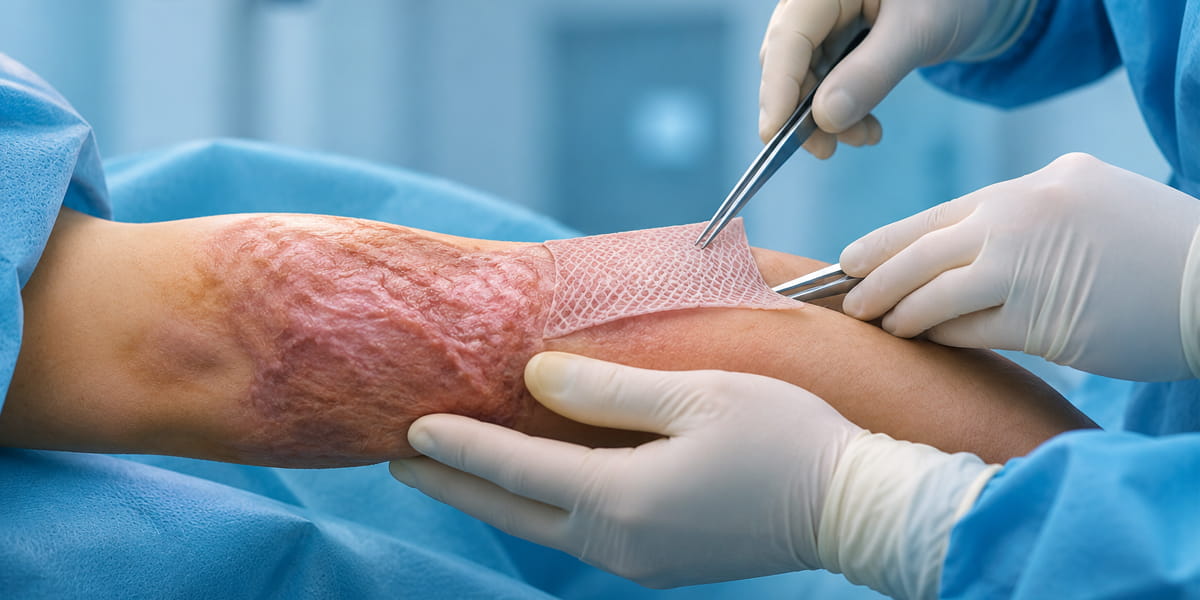
The surgeon cuts through the tight scar band so the skin can spread open and the joint or body part can move freely again. The gap is then covered with a graft or flap.
Skin Grafting
Skin grafting for burns moves healthy skin from another part of the body, called the donor site, to cover a released or damaged area. It restores cover and often improves appearance.
| Feature |
Split-thickness graft |
Full-thickness graft |
| Thickness |
Top layer and part of the dermis |
The entire dermis, so it is thicker |
| Donor site |
Heals on its own, like a graze |
Closed with stitches, so only smaller areas are taken |
| Appearance |
May look shiny or uneven and can contract more |
Closer to normal skin, with less contraction |
| Typical use |
Large areas |
Small, visible areas such as the face, hands and joints |
Flap Surgery
A flap moves nearby skin together with its underlying fat and blood vessels. Because it brings its own blood supply, it gives thicker, softer cover and helps restore movement over joints and tendons.
Z-plasty
The surgeon makes Z-shaped cuts so that two triangles of skin swap places. This repositions the scar, lengthens tight areas and releases tension across joints.
Fat Grafting and Dermal Substitutes
Fat grafting places small amounts of your own fat beneath a scar, which can soften it and improve the quality of the skin above. Dermal substitutes act as a scaffold that supports skin repair.
Non-Surgical Treatment
Many scars improve with non-surgical care, alone or before surgery.
- Silicone sheets or gel: keep the scar hydrated and help it flatten and soften.
- Pressure garments: apply steady pressure so healing scars stay flatter and less red.
- Laser therapy: uses light energy to improve scar colour, texture and thickness.
- PRP: uses growth factors from your own blood to support skin repair.
- Microneedling: makes tiny channels in the skin to stimulate collagen and smooth the surface.
Complex cases often need more than one stage. A plan may unfold over several months, so the skin can heal and settle between steps.
When Should You Consider Burn Scar Treatment?
Scars usually keep changing for 12 to 18 months, so many are treated once they mature. A contracture that limits movement or function may need earlier release.
Even so, it is ideal to see a plastic surgeon near you in Varanasi soon after a burn. Early burn treatment in Varanasi, with guidance on positioning, splints, and scar care, can reduce problems later. The right time depends on the scar, the area, and the person.
Recovery & What to Expect
Scars can usually be improved, softened, and made less restrictive, but not erased.
- Healing timeline: Grafts begin to take in about the first week, and wounds usually settle over two to three weeks. The scar then keeps maturing for 12 to 18 months or longer.
- Hospital stay: This depends on the size and site of surgery. Smaller procedures may need a short stay, while extensive reconstruction can need longer. Your surgeon will explain this beforehand.
- Follow-up visits: Visits are frequent in the first weeks for dressing checks, then spaced out over the following months. Your surgeon will set your schedule.
- Post-operative care basics: Keep dressings clean and dry. Follow splint and physiotherapy advice. Protect healed skin and grafts from sun and knocks with sunscreen and clothing, and avoid scratching or pulling at the area.
Recovery After Burn Reconstruction Surgery in Varanasi
| Stage |
Time frame |
What is done |
| Wound healing |
First 1 to 3 weeks |
Dressings, graft and donor-site care, and splinting where needed |
| Early rehabilitation |
Weeks 2 to 6 |
Stitches removed, and gentle movement and physiotherapy begin as advised |
| Scar care |
1 to 6 months |
Silicone, pressure garments, massage and stretching as advised |
| Scar maturation |
6 to 18 months |
Reviews of movement and scar softening, with further treatment if needed |
Possible Risks and How We Manage Them
Every surgery carries some risk. Knowing what they are helps you feel prepared, and most can be reduced with careful planning and aftercare.
- Infection: Sterile technique, careful dressings and, where needed, antibiotics lower the risk.
- Scarring: New scars at the incision or donor site are possible. Careful incision planning, gentle handling and scar care with silicone and pressure help keep them fine.
- Reduced mobility: Tight scars can return without movement. Physiotherapy, splints and stretching help protect the result.
- Graft failure: Part of a graft may not take. It is watched closely and can often be managed with dressings, a further small graft or another technique.
Common effects include swelling, bruising, tightness, itching and colour mismatch. Less commonly, people may have donor-site scarring, scar recurrence, keloid formation or anaesthesia-related risks.
Surgery is safest when it is planned by a qualified plastic surgeon, in an appropriately equipped facility, with realistic goals and a staged plan. Please ask questions at any point.
When to call us: Contact your plastic surgeon in Varanasi if you have fever, spreading redness, pus, increasing pain, or a change in graft colour.
How Much Does Burn Reconstruction Surgery Cost in Varanasi?
Costs vary widely. As a general guide across India, burn contracture release with skin grafting often falls between roughly ₹20,000 and ₹65,000 or more per procedure. Your own estimate for burn surgery in Varanasi will depend on:
- The severity of the burn and the type of scar
- The size of the area to be treated
- The technique used, such as a graft, flap or Z-plasty
- The number of stages, the hospital stay and follow-up care
These figures are indicative only. A written estimate is given after assessment.
Coverage: Reconstructive surgery that restores function is sometimes covered by insurance or government schemes, but coverage varies. Please confirm with your doctor during consultation.
Support Beyond the Operating Room
Living with visible scars can be heavy, and it is normal to feel tired, self-conscious or unsure. Counselling and peer support can help alongside surgery. We encourage you to bring a family member or friend to your consultation. They can listen, ask the questions you might forget, and be with you through each step.
Burn Scar Myths vs Facts
| Myth |
Fact |
| Scars can be removed completely. |
They can be improved, not erased. |
| Surgery must be done immediately. |
Timing depends on function and scar maturity. |
| A skin graft will match perfectly. |
Colour and texture often differ somewhat. |
| Old burn scars can’t be helped. |
Many long-standing scars and contractures can still be improved. |
| Home remedies can fade deep burn scars. |
They may help with mild marks but cannot release a contracture. |
जलने के दाग का इलाज — आपको क्या जानना चाहिए
Looking for jalne ke daag ka ilaj in Varanasi?
जले के निशान तब बनते हैं जब गहरी जलन के बाद त्वचा की भीतरी परतें ठीक होते समय सख़्त और मोटे निशान ऊतक से भर जाती हैं। कई बार यह निशान त्वचा को खींचकर जोड़ों, गर्दन, हाथ या चेहरे की गति को सीमित कर देता है, जिसे कॉन्ट्रैक्चर कहते हैं। बर्न स्कार सर्जरी में तंग निशान को खोला जाता है और ज़रूरत के अनुसार स्किन ग्राफ्ट, फ्लैप या ज़ेड-प्लास्टी की मदद ली जाती है। सर्जरी आमतौर पर तब सुझाई जाती है जब घाव पूरी तरह भर चुका हो और निशान स्थिर हो रहा हो, या जब कसाव से हिलने-डुलने में दिक्कत हो, या दिखावट को लेकर चिंता हो। सही इलाज डॉक्टर की जांच के बाद ही तय होता है।
Take the First Step at Your Own Pace
If an old burn has affected your movement, comfort, or confidence, you deserve an unhurried conversation about your options. A consultation at Banaras Plastic Surgery Hospital is a chance to ask questions, understand what is realistic, and decide in your own time. You are welcome to bring a family member with you. Whenever you feel ready, we are here to talk it through.
Call us at +91 95656 22223, or book an appointment at a time that suits you.