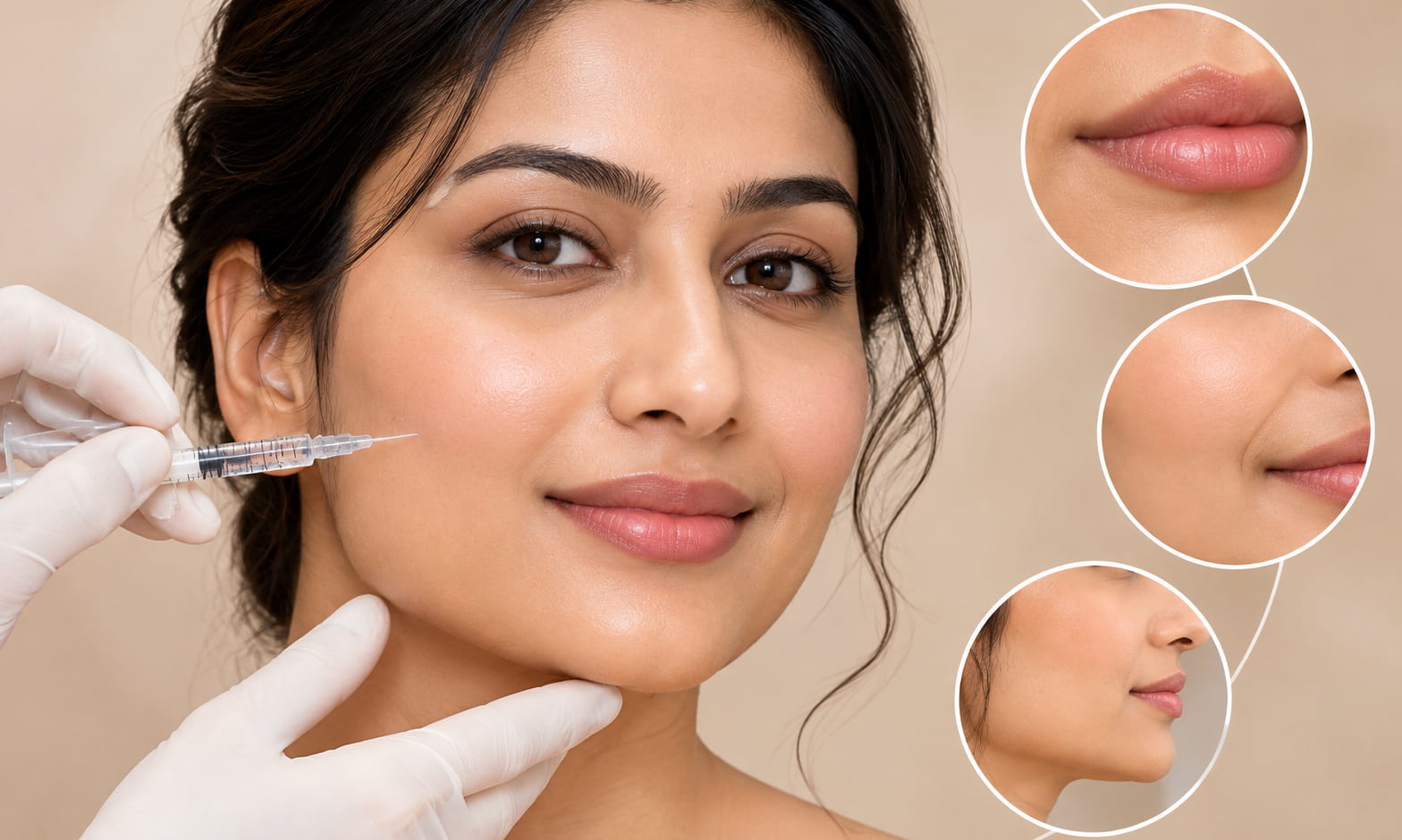
Refresh Tired Features Instantly—Restore Volume and Softer Lines with a Subtle, Non-Surgical Touch
Some changes arrive quietly. The cheeks lose their fullness, so your face looks tired even after a good night's sleep. Lines deepen around the mouth. Lips turn thinner, or a jawline loses the definition it once had. These changes are common, and many of them come from gradual volume loss, not anything you did or didn't do. At Banaras Plastic Surgery Hospital in Varanasi, dermal filler treatment is approached as a careful conversation first and an injection second.
The goal is to restore balance gently, so people notice that you look rested, not that you've had something done.
What Is Dermal Filler Treatment?
Dermal filler treatment is a non-surgical procedure in which a trained aesthetic or plastic surgeon injects a soft, gel-like substance under the skin to restore lost volume, smooth lines and folds, or add definition to areas such as the lips, cheeks and jawline.
Unlike surgery, there are no incisions and no general anaesthesia. Treatment is done in a single session in a clinical setting, and most people return to routine activities soon after. The trade-off is that the body gradually absorbs the filler, which is why many patients return for maintenance.
One distinction you must mark while considering a dermal filler treatment in Varanasi: dermal filler adds volume, while botulinum toxin (Botox) relaxes the muscles that cause expression lines. Both are not the same.
What Are Dermal Fillers Made Of?
Most dermal fillers are smooth gels made from substances that resemble or work with the body's own tissue. Hyaluronic acid, a sugar molecule found naturally in skin that holds water, is the most widely used. Calcium hydroxylapatite, a mineral also found in bone, or poly-L-lactic acid, a biodegradable material, encourages the skin to produce collagen. Each is processed to a particular thickness so it suits a specific part of the face.
Types of Dermal Fillers
- Hyaluronic acid (HA) fillers. The most commonly used type. Soft and flexible, hyaluronic acid filler suits the lips, tear troughs, cheeks, and lines.
A key advantage is that it is reversible: an enzyme called hyaluronidase can dissolve it if needed. - Calcium hydroxylapatite fillers. Firmer than HA, so they give more structural support. They are used for deeper contouring, such as the cheeks and jawline.
- Poly-L-lactic acid (biostimulators). These don't fill so much as prompt the skin to build collagen gradually. They are used when volume loss is spread across the face.
Sculptra is a commonly used PLLA Skin Booster.
Which product is right depends on the area, the depth at which it will sit, and what you want to achieve. That is decided at consultation, not in advance.
Where Dermal Filler Can Help
- Lips (lip filler): Refines shape, adds hydration, and defines the borders, without necessarily making the lips larger.
- Cheeks and mid-face (cheek filler): Restores volume and gives a gentle lift to a face that has started to look flat or tired.
- Under-eye hollows (under-eye or tear trough filler): Softens the shadowed hollow that can make eyes look tired. This is a delicate area, so suitability is assessed carefully.
- Nasolabial folds and marionette lines: The lines running from the nose to the corners of the mouth, and down from the corners of the mouth.
- Chin and jawline (jawline and chin filler): Adds definition and balance, especially when seen in profile.
- Non-surgical nose reshaping: For minor contour changes only, such as smoothing a small bump or refining the tip. It cannot make a nose smaller and is not a substitute for rhinoplasty.
- Hands: Increases volume where veins and tendons have become prominent.
- Hypotrophic scars: Depressed scars, such as some post-acne scars; fillers can be injected to fill the sunken area.
Where Is Filler Placed in the Skin?
Filler is placed at different depths depending on what it is meant to correct. For fine lines and some scars, it goes into the dermis, the layer of skin just beneath the surface. For volume in areas such as the lips or cheeks, it may be placed subcutaneously, in the tissue just under the skin. For structure and contour, such as the chin or jawline, it can be placed in the supraperiosteal region, just above the bone.
Once injected, the filler stays in that region until the body gradually metabolises it. This typically takes 6 to 18 months, depending on the individual and the kind of product used.
Is Dermal Filler Right for You?
Usually a good fit
- Adults who want to restore volume or soften lines without surgery
- People who want a subtle, natural-looking result
- Those in good general health, with healthy skin at the treatment site
- Anyone who understands that results are temporary and may need maintenance
- People looking for minor contour refinement, such as lip balance or a better-defined chin
Better to wait or discuss first
- Pregnancy and breastfeeding
- An active skin infection, cold sore or acne flare at or near the treatment site
- A history of allergies, particularly to local anaesthetics or filler ingredients
- A bleeding disorder, or regular use of blood-thinning medicines
- Expectations of a dramatic or permanent change, which filler cannot deliver
Our board-certified plastic surgeon in Varanasi will go through your medical history before recommending anything. If another treatment would suit you better, that becomes part of the conversation.
How Dermal Filler Treatment Works
- Consultation and facial assessment. Our aesthetic surgeon listens to your concerns, studies your face at rest and in movement, reviews your medical history, and explains what filler can and cannot do.
- Numbing. A topical numbing cream is usually applied, and many fillers also contain a local anaesthetic to keep the injections comfortable.
- Injection. Using a fine needle or cannula, the filler is placed in small amounts at the depth chosen for you. The doctor checks symmetry as they go.
- Review. The doctor assesses the result, gently shapes the filler where needed, and goes through aftercare. A short review visit may be suggested to check how things have settled.
Recovery and Aftercare
Mild swelling, redness, and bruising are common and usually settle within a few days. Small bruises can take a little longer to fade.
Here are a few care tips you may follow for good results:
- Avoiding strenuous exercise for a short period
- Staying away from heat, such as saunas and steam rooms, for a short period
- Limiting direct sun exposure and using sunscreen
- Not pressing or massaging the treated area unless you are advised to
Follow the guidance you are given, as it is tailored to the area treated.
How Long Do Dermal Fillers Last?
Hyaluronic acid fillers generally last from several months to around 18 months, depending on the product, the area treated, and the individual. Lips tend to wear off sooner than cheeks, because they move constantly.
Because the body absorbs filler gradually, the result softens over time instead of ending abruptly. Many patients choose maintenance sessions to keep the look steady, and the timing is guided by your doctor, not a fixed calendar.
Risk & Side Effects of Dermal Filler
Dermal fillers are generally considered safe. However, every injectable still carries some risk, and it helps to know what to expect.
Common and usually temporary: redness, swelling, bruising, tenderness at the injection points, and small lumps or unevenness that often settle on their own or can be corrected by the doctor.
Rare but serious: vascular occlusion. In rare cases, filler can block or press on a blood vessel and reduce the blood supply to the skin. This needs urgent attention. The warning signs are:
- Severe or increasing pain
- Pale or blanched skin
- A change in skin colour, such as a bluish or mottled patch
- Any change in vision
If you notice any of these after treatment, contact your doctor immediately or seek emergency care.
A Good Fact: Dissolving the filler. Hyaluronic acid filler can be dissolved with hyaluronidase if there is a complication or you are unhappy with the result.