Restore Your Hairline Naturally, One Follicle at a Time
A receding hairline, a thinning crown, or baldness is becoming a common issue for both men and women, including individuals in their twenties. Are you one of them & looking for a hair transplant in Varanasi?
At Banaras Plastic Surgery Hospital, our board-certified aesthetic surgeons offer advanced treatments like FUE hair transplant to effectively address hair loss and baldness.
Common Causes of Hair Loss
- Genes and hormones (androgenetic alopecia): The most common cause. Follicles that are sensitive to the hormone DHT shrink over time and grow thinner hair.
- Stress and illness (telogen effluvium): A major illness, fever, surgery, childbirth or crash dieting can push many hairs into the shedding phase at once.
- Nutritional gaps: Low iron, vitamin D or protein can weaken hair growth.
- Thyroid and hormonal changes: Thyroid disorders, PCOS, pregnancy, and menopause can all thin the hair.
- Autoimmune hair loss (alopecia areata): The immune system attacks the follicles and causes round, patchy loss.
- Scalp infections and skin conditions: Fungal infections, severe dandruff or psoriasis can cause shedding.
- Tight hairstyles (traction alopecia): Constant pulling on the roots can damage follicles over time.
- Scarring conditions and injuries: Burns, surgery, trauma, and some inflammatory diseases destroy follicles, so hair does not grow back on its own.
- Medicines and treatments: Chemotherapy and certain drugs can cause shedding.
Some of these causes are temporary. Others need medical treatment first. Hair transplant is suitable only for some, which is why a proper diagnosis comes before any decision about surgery.
Male Hair Loss vs. Female Hair Loss
Hair loss follows different patterns in men and women, and that changes how it is assessed and treated.
| Feature | Male pattern hair loss | Female pattern hair loss |
| First sign | Receding hairline at the temples and thinning at the crown | Widening part and thinning spread over the top of the scalp |
| Hairline | Often recedes | Usually stays in place |
| How it is graded | Hamilton–Norwood scale (stages 1 to 7) | Ludwig scale (grades I to III) |
| Final pattern | Can progress to a bald top with a band of hair at the sides and back | Rarely leads to total baldness; thinning stays spread out |
| Usual onset | Often begins from the late teens onward | Often noticed around or after menopause, but can start earlier |
| Main drivers | Genes and sensitivity to DHT | Genes plus hormonal changes, and sometimes iron, thyroid or other health factors |
| Donor area | A stable band at the back and sides, usually well defined | Less clearly defined, because thinning is spread out |
| Transplant suitability | Good candidates have a stable pattern and enough donor hair | Selected cases only, such as localised thinning, hairline lowering, or traction and scarring areas |
| Medical treatment | Minoxidil and finasteride are commonly prescribed | Minoxidil is commonly used; finasteride is generally avoided if pregnancy is possible |
What Is FUE Hair Transplant?
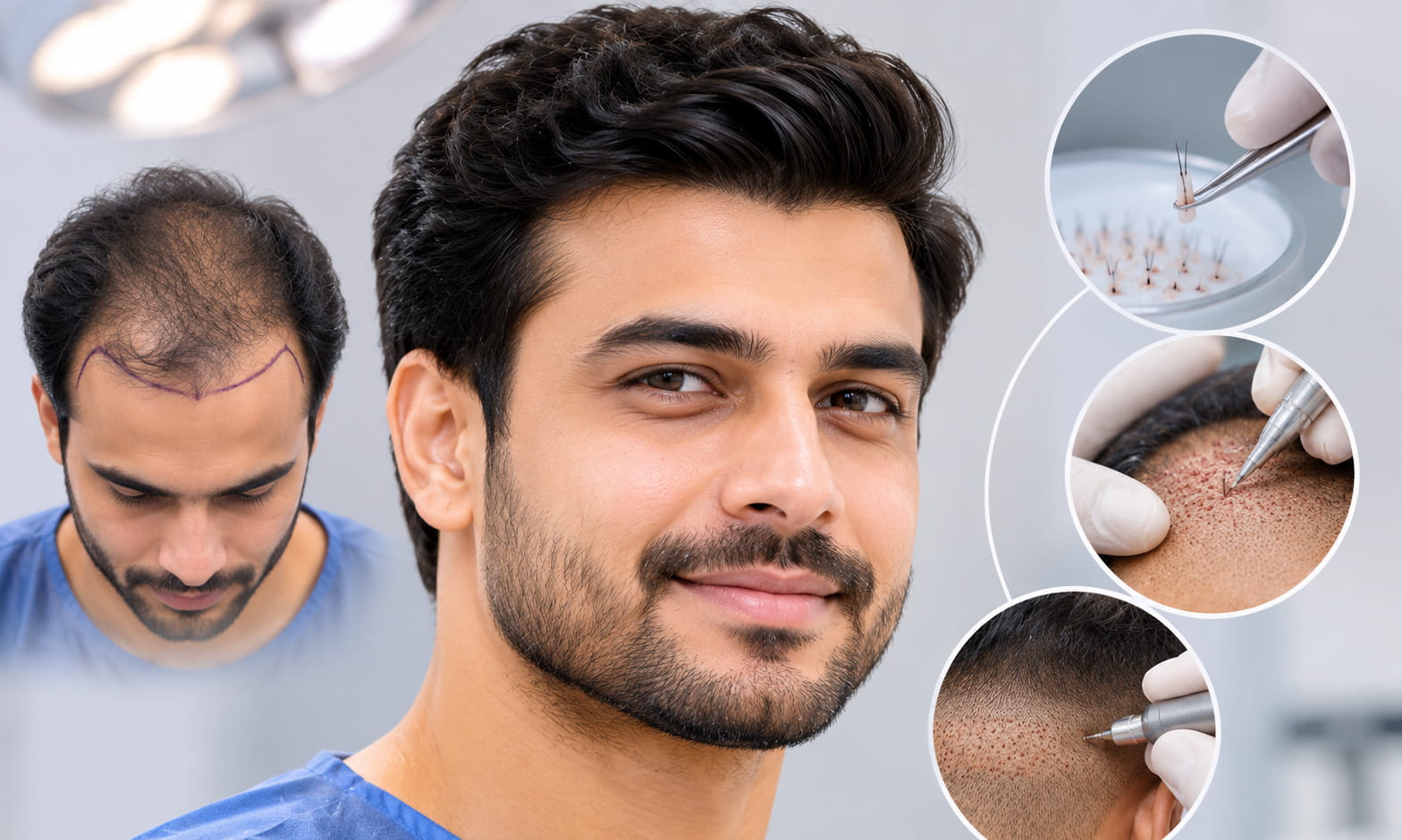
Follicular Unit Extraction (FUE) is a surgical hair restoration technique in which individual hair follicles are removed from a donor area, usually the back and sides of the scalp, and implanted into areas of thinning or baldness. The transplanted hair is generally permanent.
FUE differs from the older strip method, called FUT. No strip of scalp is cut out, so there is no long linear scar. Instead, each follicle leaves a tiny, dot-sized mark that is usually hidden by the surrounding hair.
How Do Transplanted Hairs Keep Growing?
Hair at the back and sides of the scalp is genetically resistant to DHT, the hormone behind pattern baldness. When these follicles are moved to a thinning area, they tend to keep that resistance. That is why transplanted hair usually keeps growing, while some of the native hair around it may still thin over time.
Grades of Baldness and Number of Grafts Required
Surgeons use the Hamilton–Norwood scale to describe how far male pattern baldness has advanced. A graft is a natural group of one to four hairs, so 2,000 grafts means more than 2,000 individual hairs.
| Norwood stage | What it looks like | Indicative grafts |
| 1 | No visible recession | Transplant not needed |
| 2 | Mild recession at the temples | About 500 to 1,000 |
| 3 | Deeper temple recession; thinning may begin at the crown | About 1,000 to 2,000 |
| 4 | Further recession and a thin or bald crown, with a band of hair between them | About 2,000 to 3,500 |
| 5 | Larger bald areas at the front and crown; the band between them is thinner | About 3,000 to 4,500 |
| 6 | The band is gone and the bald areas join | About 4,000 to 5,500, sometimes in two sessions |
| 7 | Only a horseshoe of hair remains at the sides and back | About 4,500 to 6,000 or more, limited by donor supply |
These numbers are estimates, not promises. The final count depends on hair thickness, density, the area to be covered and how much donor hair is available. Donor hair is limited, so a good plan protects some of it for the future. For women, graft numbers are worked out case by case, as the pattern is different.
Is FUE Hair Transplant Right for You?
Usually a good fit
- Men with a stable pattern of hair loss
- Selected women with pattern thinning
- Enough donor hair at the back and sides
- Realistic expectations about density and timing
- Good general health
Better to wait or discuss first
- Active or unexplained hair loss
- An alopecia areata flare
- A scalp infection
- Very limited donor hair
- Medical conditions that are not under control
- Very young age with a hair loss pattern that is still unpredictable
Some people do better with medical treatment or PRP therapy first, either to slow the loss or to prepare the scalp. Your doctor will tell you if that applies to you.
Where FUE Can Help
- Hairline and frontal area: Rebuilding a receding hairline with a natural shape.
- Crown and vertex: A crown hair transplant adds density at the back of the top of the head, though the crown usually needs more grafts than people expect.
- Beard and moustache: Filling patchy or sparse areas (see below).
- Eyebrows: An eyebrow transplant can restore thin or missing brows.
- Scar camouflage: Placing hair into scars left by burns, injury, or surgery.
- Women's hairline and localised thinning: In selected cases only.
Beard Transplant in Varanasi
What It Does
A beard transplant fills patchy, sparse or scarred areas of the beard and moustache. It can also define the jawline, sideburns or cheek line. Each graft is placed at an angle that follows the natural direction of beard growth.
Donor Area
Hair is usually taken from the back and sides of the scalp. In some cases, other areas of the body may be considered after assessment. Scalp hair can grow longer than natural beard hair, so transplanted hair may need regular trimming.
Recovery Timeline
- First few days: Mild redness, swelling and tiny scabs around each graft.
- Around one to two weeks: Scabs fall away as the skin settles.
- Weeks two to four: Transplanted hairs shed. This is normal.
- Around three to four months: New growth begins.
- Around nine to twelve months: The beard gradually looks fuller.
Expected Result
A beard transplant builds density slowly, over many months. The aim is a natural look that blends with your existing beard. Results depend on your donor hair, your skin and how you follow aftercare. Suitability is decided after an assessment.
What Happens During FUE Hair Transplant
- Consultation, scalp and donor assessment, and a graft estimate. The doctor reviews your history, examines your scalp and donor area, and estimates how many grafts you may need.
- Hairline design and planning. Hairline design is done with you. It considers your age, face shape, and future hair loss, so the result still looks natural years later.
- Extraction and Harvesting of follicles. The donor area is trimmed short and numbed with local anesthesia. Using a fine punch tool less than 1 mm wide, the surgeon separates each follicular unit, a natural group of one to four hairs, from the surrounding skin and lifts it out.
Follicles are taken evenly across the donor area, so no single patch looks thin. The harvested grafts are checked, sorted by hair count, and kept in a protective solution until they are placed. - Implantation of Hair Grafts. Tiny openings are made in the thinning area, and the grafts are placed in them at the right angle and direction.
- New Growth. After the first few months, the transplanted hair will shed, and new hair will grow from the follicles (once the dormant cycle passes).
Hair Transplant in Varanasi: Recovery and Aftercare
Hair transplant recovery is gradual. Redness, swelling and tiny scabs are expected in the first week or two. Here's what you may follow:
- Washing: how and when to wash the scalp gently
- Sun and heat: avoiding direct sun, hot environments and dusty places for a time
- Sleeping position: keeping your head raised for the first few nights
- Exercise: avoiding strenuous activity for the period your doctor advises
- Touching: not scratching, rubbing or picking at scabs
All of this should be done as advised by your hair transplant surgeon in Varanasi, because timing varies from person to person.
When to call us: Contact the hospital if you notice increasing pain, redness that spreads, pus, fever, or heavy bleeding.
When Will I See Results?
Most people see new hair growth from around three to four months after FUE. Visible density comes at six to nine months, and the final result usually takes 12 to 18 months. This hair transplant results timeline is a general guide, and everyone heals at a different pace.
| Timeframe | What to expect |
| First few weeks | Scabs settle. Transplanted shafts fall out. This shedding is normal. |
| Around 3 to 4 months | New hair begins to grow, often fine at first |
| 6 to 9 months | Hair thickens and density becomes visible |
| 12 to 18 months | The final result takes shape |
Patience matters here. Many people judge the result too early, during the shedding phase, when the new hair has not yet had time to grow.
Risk and Side Effects of FUE Hair Transplant
Common and usually temporary: swelling, redness, scabbing, numbness in the treated areas, itching, and shedding of the transplanted hairs.
Less common: folliculitis (small pimple-like inflammation around follicles), uneven growth, small visible marks in the donor area, and poor survival of some grafts.