Mole removal has become one of the most commonly searched cosmetic concerns in India — and for good reason. With more people becoming aware of both cosmetic and medical reasons to remove moles, the next question that follows is almost universal: which method is actually safe for skin like mine?
Indian skin behaves differently under certain treatments, and knowing that difference before you book a procedure can make a significant impact on your result.
Two methods dominate mole removal today — laser treatment and surgical excision. Here is a clear, section-by-section breakdown of both.
What is laser mole removal?
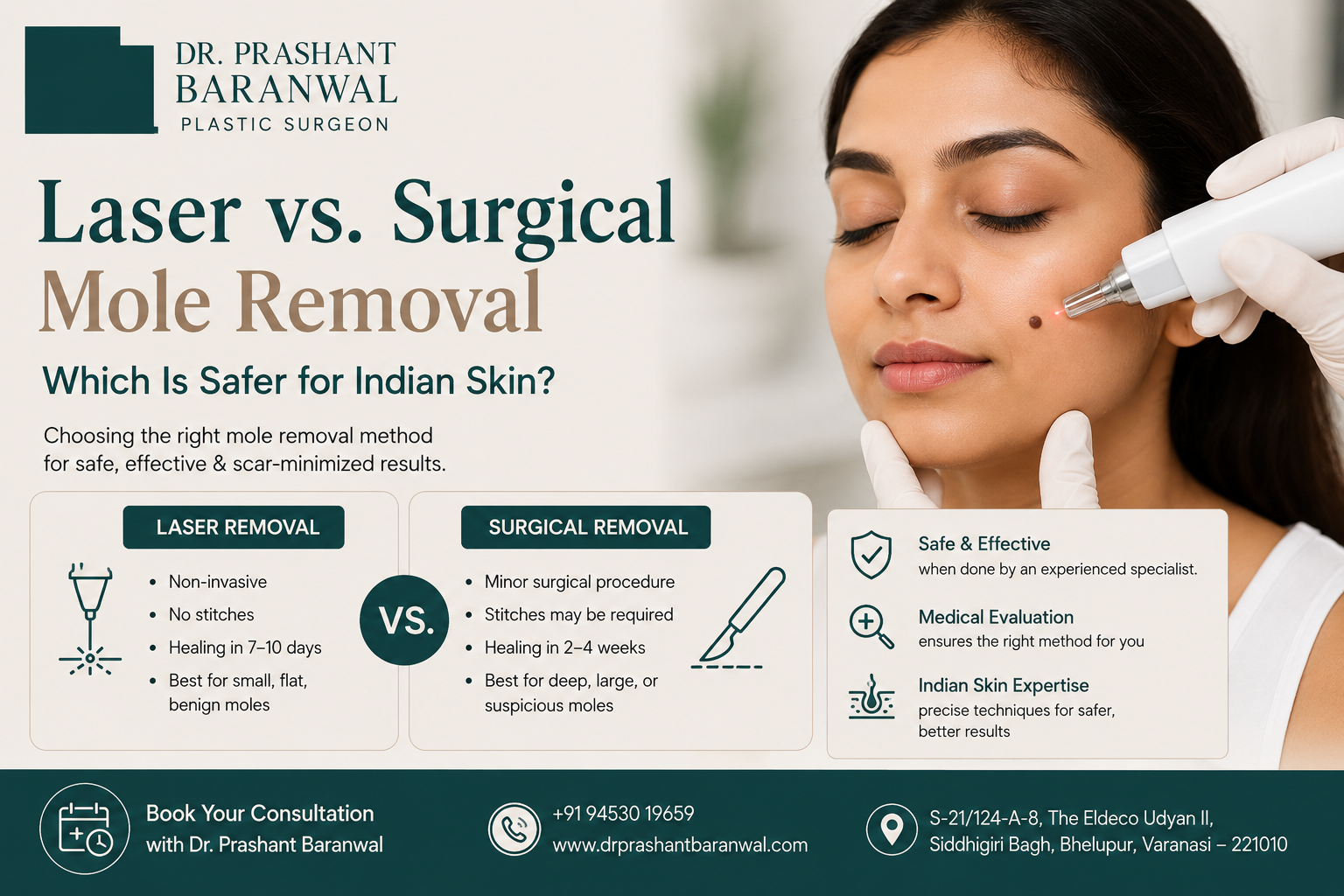
Laser mole removal uses focused light energy to break down the pigmented cells that form the mole. The body then flushes out these broken-down cells naturally over the days following the procedure.
There are no cuts and no stitches involved. A numbing cream is applied before the session, and the procedure itself takes around 20 to 30 minutes. Most patients describe it as a mild snapping sensation — nothing more.
Who is it best suited for?
- People with small, flat, or superficial moles
- Moles that have been confirmed as benign by a doctor
- Those who want minimal downtime — healing takes 7 to 10 days
- Moles on the face or neck where avoiding a visible scar is a priority
One important limitation to know
Laser vaporises the mole cells. This means there is no tissue left to send to a lab for testing. If there is any medical uncertainty about a mole, laser is not the right method — surgical removal must be considered instead.
What is surgical mole removal?
Surgical excision involves removing the mole physically using a small surgical blade under local anaesthesia. The area is numbed completely before the procedure begins, so there is no pain during the removal.
Depending on the depth of the mole, the surgeon may place a few fine stitches to close the skin. The full procedure is typically completed within 30 to 45 minutes.
Who is it best suited for?
- Deeper, larger, or raised moles
- Moles with irregular borders, uneven colour, or recent changes
- Any mole that needs tissue analysis to rule out medical concerns
- Moles that have been present since birth and have grown noticeably over time
What makes surgery the more complete option
The extracted mole can be sent directly to a pathology lab. This is the most significant clinical advantage surgery holds over laser — it provides a tissue sample for examination, which is essential whenever a mole raises any concern.
Healing after surgery takes 2 to 4 weeks. A fine scar is expected but fades considerably over months with proper aftercare.
How does Indian skin respond differently to each method?
This is the section that most mole removal blogs overlook — and it is the most relevant part for anyone reading this in India.
The melanin factor
Indian skin produces more melanin than lighter skin tones. Melanin gives us our colour, but it also makes darker skin more reactive to heat and light-based treatments like lasers.
When laser settings are not precisely calibrated for darker skin, a condition called post-inflammatory hyperpigmentation can develop. This means the treated area heals darker than the surrounding skin — the opposite of what the patient wanted.
Does this make laser unsafe for Indian skin?
No — but it does make the doctor's experience non-negotiable.
In skilled hands, with the right laser type and correct energy calibration, laser mole removal is very safe for Indian skin. The risk arises when a clinic uses a standardised approach without adjusting for skin tone. In cities like Varanasi, where skin tones vary across a wide range, this distinction becomes especially important.
How does surgery compare on this front?
Surgical removal does not involve heat or light energy, so the hyperpigmentation risk is far lower. The healing process is consistent regardless of skin tone, making it a more predictable option — particularly for patients who are concerned about post-treatment pigmentation or have had skin reactions to light-based treatments before.
Laser vs. surgical removal — a quick side-by-side
| Laser removal | Surgical removal | |
| Procedure type | Non-invasive | Minor surgical |
| Anaesthesia | Numbing cream | Local injection |
| Healing time | 7–10 days | 2–4 weeks |
| Scarring | Minimal to none | Fine scar, fades over time |
| Tissue testing | Not possible | Yes, sample can be sent to lab |
| Sessions needed | 1 to 3 sessions | Single session |
| Best for | Flat, benign, superficial moles | Deep, suspicious, or larger moles |
| Indian skin risk | Pigmentation if miscalibrated | Low, skin-tone neutral |
What about recovery — what should you actually expect?
After laser removal
A small scab forms on the treated area and falls off naturally within 7 to 10 days. The skin beneath is new and sensitive.
- Keep the area clean and dry
- Avoid direct sun exposure completely during healing
- Apply the prescribed ointment as directed
- Do not pick at the scab — it increases the risk of scarring
Sun exposure is the most common reason pigmentation issues appear after laser treatment. In Varanasi's climate, where sun intensity is high for most of the year, this aftercare step is non-negotiable.
After surgical removal
Stitches are removed within 5 to 7 days. The area should be kept clean and dry in the initial days.
- A faint raised scar is normal in the first few weeks
- It gradually flattens and lightens over the following months
- Silicone-based scar gels are commonly recommended to speed up fading
- Sun protection over the scar is equally important
In both cases, how carefully the aftercare instructions are followed has a direct impact on the final result — often more so than the method itself.
How do you know which method is right for your mole?
The honest answer is — you need a doctor to tell you after looking at it in person. No responsible clinic recommends a removal method without first examining the mole.
That said, here are signals that point toward each method:
Signs laser may be the right fit
- The mole is small, flat, and has been unchanged for years
- A doctor has confirmed it is benign
- It is on the face and you want to avoid any visible mark
- Your skin has tolerated laser treatments well in the past
Signs surgery may be the right fit
- The mole has changed recently in size, colour, or shape
- It is raised, deep-rooted, or larger than 6mm
- Your doctor has recommended a biopsy
- The mole has irregular or blurred borders
If you are unsure which category your mole falls into, that uncertainty itself is a reason to get a proper consultation rather than booking a procedure based on what you have read online.
The right place to start in Varanasi
Choosing a method is only half the decision. Choosing where to get it done — and by whom — is what actually determines your result.
At Banaras Plastic Surgery Hospital, Dr. Prashant Baranwal assesses every mole individually before recommending any course of action. With focused experience in cosmetic surgery in Varanasi and a thorough understanding of how Indian skin responds to both laser and surgical techniques, every recommendation here is based on what is clinically appropriate for your skin — not what is most convenient to offer.
If you have a mole you have been putting off getting looked at, a consultation is the simplest and most sensible first step you can take.
People Also Ask
Can laser mole removal cause dark spots on Indian skin?
Yes, it can — if the laser settings are not calibrated for darker skin tones. Indian skin has higher melanin content, which makes it more reactive to heat-based treatments. A specialist experienced with Indian skin tones will adjust the laser energy accordingly. Choosing a qualified and experienced doctor is the most important factor in avoiding this outcome.
Will the mole grow back after removal?
Surgically removed moles rarely grow back because the entire mole, including the deeper cells, is removed in one session. Laser-treated moles have a slightly higher chance of partial recurrence, particularly if the mole was deep and required multiple sessions. Your doctor will assess this based on the mole's depth and characteristics.
Is mole removal painful?
No, not during the procedure. Both methods use local anaesthesia or numbing cream, so the actual removal is painless. You may feel mild pressure during surgical excision or a faint snapping sensation during laser — both are very well-tolerated by most patients.
Does surgical mole removal always leave a visible scar?
A fine mark is common after surgery, but "visible" depends on the surgeon's technique and your aftercare. In experienced hands using precise closure methods, scars fade significantly over 3 to 6 months. Consistent sun protection and scar management products help the mark become difficult to notice over time.
How do I know which mole removal method is right for me?
Only a doctor can confirm this after examining the mole in person. The decision depends on the mole's size, depth, location, your skin tone, and whether it shows any suspicious features. A consultation before any procedure is the most important step — it ensures the method chosen is appropriate for your specific situation, not just the most convenient option available.