When vitiligo affects a hair-bearing area, some people notice something beyond white skin. The hair growing from the patch may also turn white. This is called leucotrichia. Understanding the difference between ordinary grey hair and white hair in vitiligo can be important when considering surgical repigmentation.
In my practice, I find that patients often focus on the skin patch first. Later, they ask a more specific question: “If the hair is also white, does that change the treatment?” The answer depends on what is happening around the hair follicle, how stable the vitiligo is, and which area is affected.
What is leucotrichia in vitiligo?
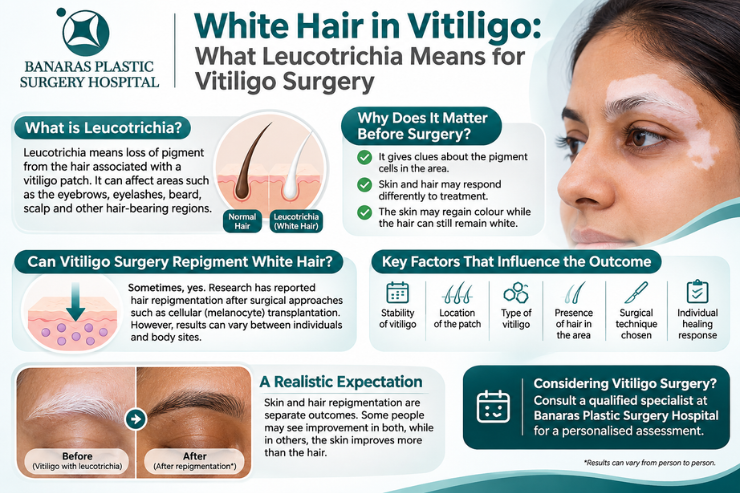
Leucotrichia means loss of pigment from the hair associated with a vitiligo patch.
It can occur on areas such as:
- Eyebrows
- Eyelashes
- Beard
- Scalp
- Body hair
- Other hair-bearing areas affected by vitiligo
This is different from normal age-related greying. In vitiligo, the white hair is associated with pigment loss in an area affected by the condition.
Hair follicles contain pigment-producing cells and can act as an important reservoir of melanocytes. When these pigment cells are affected, both the skin and hair may lose colour.
That is why leucotrichia vitiligo deserves separate consideration during treatment planning.
Why does white hair in vitiligo matter before surgery?
The presence of white hair does not automatically mean that surgery will not work.
However, it can provide useful information about the pigment cells in the affected area.
The skin and hair follicle do not always respond in exactly the same way. A patch may regain some skin colour while the hair remains white. This difference has been reported after medical treatment as well as surgical repigmentation.
This matters because a person may consider the treatment incomplete even when the skin has improved.
For example, imagine a vitiligo patch on the eyebrow. The surrounding skin may regain colour, but the eyebrow hairs may remain white. The contrast can still be visible.
Therefore, when evaluating vitiligo surgery, I would look at the skin and the hair separately rather than assuming that repigmentation of one means repigmentation of the other.
Can vitiligo surgery repigment white hair?
Sometimes, but it is important not to treat this as a guaranteed outcome.
Research has reported repigmentation of leucotrichia following different surgical approaches, including non-cultured cellular grafting. However, the degree of hair repigmentation has varied between patients and body sites.
One proposed explanation is that melanocytes introduced or restored in the repigmented skin may contribute to pigment restoration around the hair follicle. Research has also explored the role of hair follicle-associated melanocytes in this process.
This is an important point because melanocyte transplant for white hair is not simply a matter of putting pigment directly into each white hair.
The aim of cellular transplantation is to restore pigment-producing cells to the affected area. How those cells behave afterward can influence the final pattern of repigmentation.
Why can skin repigment while the hair stays white?
This is one of the most confusing parts of vitiligo treatment.
Skin and hair pigmentation involve related but distinct structures. The hair follicle has its own pigment-producing system.
Conventional medical treatments may restore colour to the skin in some patients without restoring pigment to already white hairs. This is one reason leucotrichia can remain noticeable even after successful skin repigmentation.
Surgical treatment has shown that hair repigmentation can sometimes occur alongside skin repigmentation. But studies have also shown that the response can differ according to the treatment method and anatomical site.
So, the question should not simply be:
“Will my vitiligo patch regain colour?”
A more useful question is:
“What are the realistic expectations for both the skin and the affected hair?”
Does the location of white hair affect vitiligo surgery?
It can.
Different hair-bearing areas have different anatomical characteristics. The response of eyebrow, beard, scalp and body hair should not automatically be assumed to be identical.
Earlier surgical research reported differences in the timing and extent of hair repigmentation between areas such as the eyebrows, scalp and beard. More recent studies have also examined hair repigmentation as a separate outcome rather than treating it as identical to skin repigmentation.
For this reason, a doctor assessing vitiligo surgery in Varanasi should consider the location of the patch, the presence of leucotrichia, the extent of involvement and the overall stability of the condition.
Is white hair a sign that vitiligo is more difficult to treat?
Not necessarily.
Leucotrichia can indicate involvement of pigment cells associated with the hair follicle, but it should not be used by itself to predict the final result of surgery.
Other factors matter too, including:
- Whether the vitiligo has remained stable
- Size and location of the patch
- Type of vitiligo
- Presence of hair within the affected area
- Condition of the surrounding skin
- Surgical technique being considered
- Individual healing and repigmentation response
Studies comparing cellular transplantation methods have found that skin repigmentation and hair repigmentation can behave differently. Individual studies also differ in their results, which is why treatment outcomes should not be promised in advance.
What should you ask before considering surgery for leucotrichia?
If you have white hair within a vitiligo patch, a consultation should go beyond asking whether surgery is possible.
Useful questions include:
- Is my vitiligo stable enough for surgical treatment?
- Is the white hair actually leucotrichia?
- Does the location of the patch affect the treatment approach?
- Is the goal to repigment only the skin, or also the hair?
- Which surgical technique is appropriate for my particular patch?
- How should skin and hair repigmentation be assessed separately?
- What degree of improvement is realistically possible in my situation?
- What happens if the skin improves but the hair remains white?
Someone searching for a vitiligo specialist in Varanasi should also make sure the consultation includes a discussion of these individual factors rather than focusing only on the name of a procedure.
Is melanocyte transplantation suitable for every vitiligo patch with white hair?
No.
Surgical repigmentation is generally considered for selected patients, particularly when the vitiligo is stable and other factors make surgery appropriate.
The presence of leucotrichia does not, by itself, establish surgical candidacy.
Different cellular techniques have been studied for stable vitiligo, including non-cultured epidermal cell suspension and hair follicle-based cell suspension. Research suggests that both can produce repigmentation, but their results and advantages are not identical in every study.
The decision should therefore be based on an examination of the individual patch rather than a general promise that one technique will restore both skin and hair.
What should patients realistically expect from vitiligo surgery?
The most useful expectation is not a fixed percentage or a guaranteed result.
Instead, patients should understand that skin repigmentation and hair repigmentation are separate outcomes.
Some people may see improvement in both. Others may see more noticeable improvement in the skin while the hair remains partly or completely white. Research has documented both possibilities.
That does not mean that leucotrichia makes surgery impossible. It means that the treatment discussion needs to be more detailed.
When considering vitiligo surgery white hair should be discussed as part of the overall assessment, especially when the patch involves the eyebrows, beard, scalp or another visible hair-bearing area.
A Clearer Way To Approach Leucotrichia
White hair within a vitiligo patch can raise a different set of questions from those raised by skin depigmentation alone. The important issue is not simply whether the hair is white. It is understanding what that finding means for the treatment plan and what can reasonably be expected.
If you are considering surgical repigmentation, discuss the stability of your vitiligo, the affected body area, the presence of leucotrichia and the possible skin-versus-hair response with a qualified doctor. A personalised assessment is more useful than judging suitability from photographs or general treatment claims.
Author:
Dr. Prashant Baranwal
M.B.B.S., M.S., M. Ch
Plastic & Cosmetic Surgeon
Director, Banaras Plastic Surgery Hospital.
Medical Disclaimer: This article is intended for general educational purposes and does not constitute medical advice. Vitiligo and its treatment can vary from person to person. Individual results may vary. Surgical treatment may not be appropriate for everyone. Please consult a qualified medical practitioner for a personalised assessment of your condition.