Weeks after a surgical wound heals, many people notice something unexpected. The line where the stitches once were has turned thick, red, and slightly raised, and it does not look the way they imagined it would.
I hear the worry behind this often: "Is this normal, or is something wrong?" Most of the time, the answer depends on one detail, which is whether the raised tissue stays within the original incision or begins to spread past it. That single difference separates a hypertrophic scar from a keloid, and it shapes everything about how each one is approached.
What Is a Hypertrophic Scar?
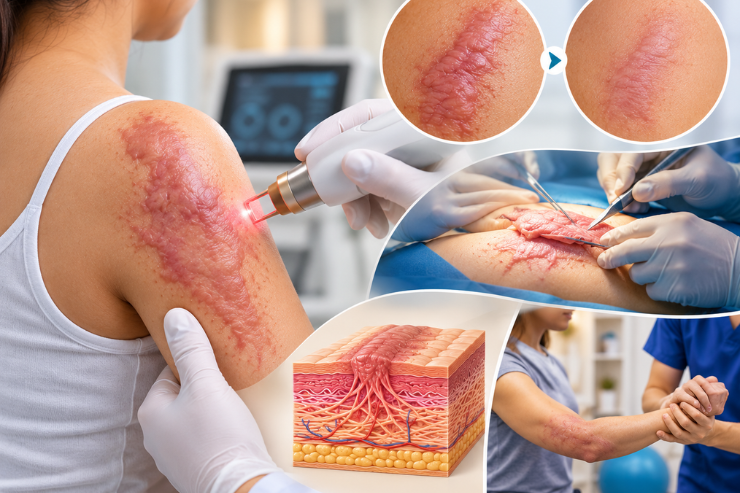
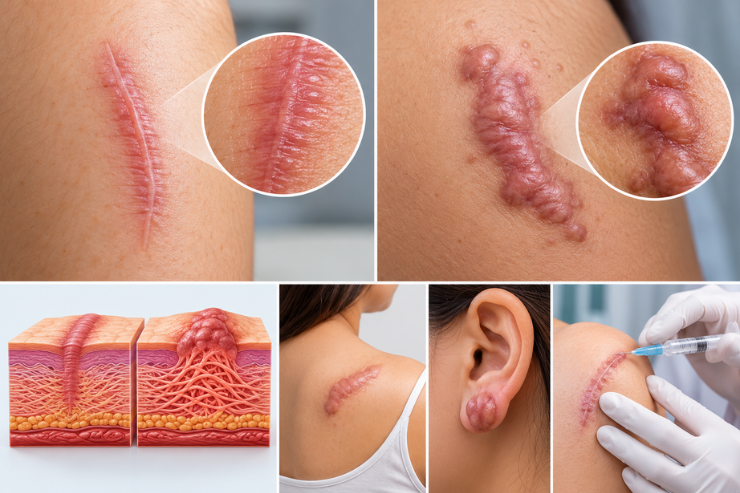
A hypertrophic scar is a raised, firm, often red or pink scar that forms when the body produces excess collagen during healing. The key feature is that it respects the wound's boundary.
Typical features:
- Appears within 4 to 8 weeks of the injury
- Remains inside the original wound margin
- May itch or feel tender in the early months
- Often softens and flattens gradually over 1 to 2 years
- Common over joints, the chest, shoulders, and areas of skin tension
What Is a Keloid?
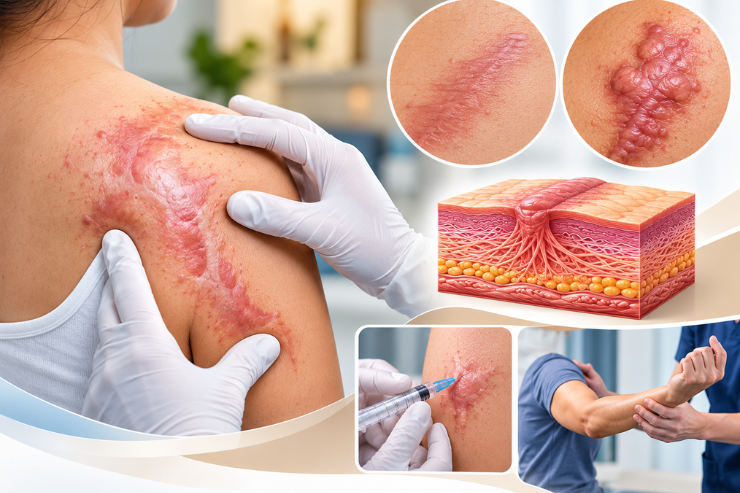
A keloid is an overgrowth of scar tissue that extends beyond the original wound. It behaves less like a scar and more like a slow-growing benign tissue mass.
Typical features:
- May appear weeks or even months after the injury, sometimes from a minor wound
- Spreads onto healthy skin around the wound
- Feels firm, rubbery, or smooth and shiny
- Can itch, ache, or feel sensitive to touch
- Does not usually regress without treatment
- Common on the earlobes, chest, shoulders, upper back, and jawline
Hypertrophic Scar vs Keloid: Key Differences
| Feature | Hypertrophic Scar | Keloid |
| Growth pattern | Stays within the wound edge | Extends beyond the wound edge |
| Time of appearance | Within weeks | Weeks to months, sometimes later |
| Natural course | Often improves over 1 to 2 years | Rarely improves; may keep growing |
| Colour | Red to pink, fading with time | Pink, red, or darker than surrounding skin |
| Recurrence after removal | Lower | Higher, especially with surgery alone |
| Common triggers | Burns, deep cuts, tension across the wound | Piercings, acne, minor cuts, vaccination sites, surgery |
Why Do These Scars Form?
The Healing Process
Every wound heals by laying down collagen. Normally, the body balances collagen production and breakdown. In these scars, that balance is disturbed. Collagen builds up faster than it is cleared, and the scar thickens.
Who Is More Likely to Develop Them?
- People with a family history of keloids
- Those with deeper skin tones, in whom keloids are more common
- Adolescents and young adults, particularly between 10 and 30 years
- Wounds under constant tension, such as those over the shoulders or chest
- Wounds that take longer than three weeks to heal
- Wounds that became infected or were left open to heal slowly
Common Triggers
- Ear and body piercings
- Acne and chickenpox marks
- Burns and scalds
- Surgical incisions
- Injection and vaccination sites
How Are They Diagnosed?
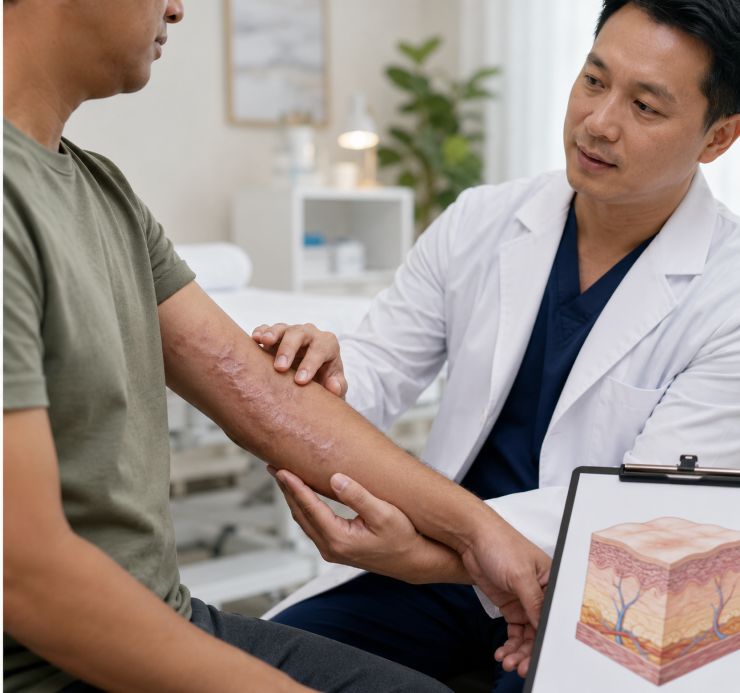
In most cases, diagnosis is clinical. This means the scar is examined, its history is discussed, and its behaviour over time is noted. A biopsy is rarely needed, though it may be considered when a growth looks unusual.
Key questions during evaluation include how long ago the injury occurred, whether the scar has spread beyond the original wound, and whether it has changed recently. A plastic surgeon in Varanasi, or any trained surgeon elsewhere, would also look at the scar's location, texture, and any family history before suggesting a plan.
Treatment Options
Treatment planning is individual. A plastic surgeon in Varanasi and a surgeon in any other city would weigh the same factors: scar type, age of the scar, location, symptoms, and skin type.
Options for Hypertrophic Scars
- Silicone gel or sheets: Worn daily for several months, these help hydrate the scar and reduce its thickness.
- Pressure therapy: Used mainly after burns, where garments apply steady pressure to flatten healing tissue.
- Massage: Gentle, regular massage may soften the scar over time.
- Corticosteroid injections: Small doses can reduce bulk, itching, and redness.
- Laser treatments: Certain lasers help with redness and texture.
- Scar revision surgery: Considered when a scar is wide, contracted, or limits movement, especially over joints.
Options for Keloids
Keloids usually need a more layered approach because they tend to return.
- Corticosteroid injections: Often the first step, given at intervals to shrink the tissue.
- Cryotherapy: Freezing the tissue from inside can help smaller or newer keloids.
- Other injectable medicines: Agents such as 5-fluorouracil are sometimes used alone or alongside steroids.
- Laser therapy: May be used to improve colour and surface texture.
- Radiotherapy: Used in selected cases after surgical removal to lower the chance of regrowth.
- Surgical excision combined with another treatment: Cutting out a keloid alone often triggers a larger recurrence. It is usually paired with injections, pressure, or radiotherapy.
Why the Right Diagnosis Matters
Treating a keloid the way one would treat a hypertrophic scar can lead to disappointment. A simple surgical removal may suit a bulky hypertrophic scar, but the same step on a keloid can result in a larger scar than before. This is why identification comes first.
Prevention and Early Care
Not every scar can be prevented, but risk can be reduced.
- Keep fresh wounds clean and covered until healed
- Avoid unnecessary piercings or elective procedures if you have a personal or family history of keloids
- Follow wound care instructions after any surgery
- Use silicone products early if a surgeon advises them
- Protect healing scars from direct sun, as sun exposure can darken them
- Avoid picking at scabs or stretching a healing wound
- Treat acne early to limit deep inflammatory marks
Common Myths About Raised Scars
- Myth: Every raised scar is a keloid.
Most are hypertrophic scars, which behave differently and often improve on their own. - Myth: Keloids are cancerous or contagious.
They are neither. They are benign overgrowths of scar tissue. - Myth: Home remedies can remove them.
Oils, onion extracts, and creams may moisturise, but no household remedy is reliably shown to flatten established keloids. - Myth: Surgery alone fixes a keloid.
Excision without follow-up treatment carries a high chance of recurrence.
When to Get a Scar Evaluated
A review is worth considering when a scar:
- Keeps growing beyond the original wound
- Remains painful or itchy for months
- Restricts movement, such as near a joint or the neck
- Changes colour, bleeds, or forms open sores
- Causes emotional discomfort or affects daily life
Conclusion
Hypertrophic scars and keloids share a raised appearance, but they follow different paths. One respects the wound boundary and often eases with time. The other spreads beyond it and needs planned, sustained care. Understanding this distinction helps in setting realistic expectations and asking informed questions.
Scar type is best confirmed through an in-person examination, and anyone curious about their own scar can consult a qualified plastic surgeon in Varanasi to understand what it is and which options are appropriate. Individual outcomes vary, and no treatment carries a guaranteed result.
Author:
Dr. Prashant Baranwal
M.B.B.S., M.S., M. Ch
Plastic & Cosmetic Surgeon
Director, Banaras Plastic Surgery Hospital.
Frequently Asked Questions
1. How can I tell if my scar is a keloid or just a raised scar?
Look at where the scar sits. If it stays within the original cut or wound, it is likely a hypertrophic scar. If it spreads onto the healthy skin around it and keeps growing, it may be a keloid. Only an in-person examination can confirm this.
2. Will a keloid go away on its own?
Usually not. Keloids tend to stay or slowly enlarge. Hypertrophic scars, on the other hand, often flatten and fade over one to two years.
3. Can a keloid come back after it is removed?
Yes, this is common when it is removed by surgery alone. That is why doctors often combine removal with other treatments, such as injections or radiation, to reduce the chance of regrowth.
4. Is it safe to get my ears pierced if I have a family history of keloids?
It carries a higher risk. Piercings are one of the most common triggers for keloids, especially on the earlobes. Discussing your history with a doctor beforehand helps you make an informed choice.
5. Are keloids harmful to health?
No, they are not cancerous and do not spread to other parts of the body. They can cause itching, tenderness, or discomfort, and some people find their appearance distressing, but they are benign.